Have you ever called a school and felt the delay before anyone could reach the right office or staff member? Many campuses still rely on phone systems built for another era. They break calls into silos and trap staff at desks. That question, Why do schools need VoIP?, starts there. A modern school handles parent calls, attendance issues, staff coordination, transport updates, and safety communication all day.
It needs one communication system that keeps those conversations moving without adding more hardware or confusion.
Why Do Schools Need VoIP?
Schools have outgrown traditional landlines. Old systems force front desks to act as traffic controllers for the whole campus. They make transfers slow, leave voicemail disconnected from email, and turn every staffing or room change into an IT task. When schools add another building or more student services, the strain grows.
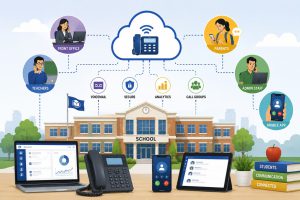
A business VoIP phone system fixes the root issue. It brings calling, routing, mobile access, texting, call records, and admin control into one cloud-based setup. Instead of patching old lines, schools can direct calls by role, department, schedule, or location. Communication stops being a fixed utility and becomes part of campus operations.
How VoIP Brings More Ease, Safety, and Value to School Communication
A school communication system has to do more than ring a desk phone. It has to move information quickly, support staff coordination, and keep parents and administrators connected without delay. That is where VoIP starts to change daily operations, giving schools a more reliable way to manage calls, urgent updates, and routine communication across the campus.
Faster Calling Between Classrooms, Offices, and Admin Teams
Internal speed shapes the school day. Dismissal changes, nurse calls, substitute coverage, maintenance requests, and transport updates all depend on quick contact between staff. VoIP makes that movement easier because teams can transfer calls, reach extensions, and answer from more than one device. Why do schools need VoIP? Because staff should reach the right person fast, even when that person is not sitting by one desk phone.
Easier Parent Communication Without Long Phone Delays
Parents do not separate school quality from school communication. If calls loop through the wrong extension or sit in voicemail too long, frustration builds fast. VoIP helps schools clean this up with auto attendants, direct extensions, voicemail-to-email, ring groups, and texting for reminders or follow-ups. Why do schools need VoIP? Because parent communication should feel organized, not improvised.
Better Emergency Calling Across School Buildings
Emergency communication changes the buying decision. A school does not need a phone line alone. It needs fast reach across buildings, support for urgent notices, and reliable escalation when seconds count. Business-grade VoIP can support e911 notifications, paging links, campus-wide alerts, and coordinated communication during lockdowns or evacuations. Why do schools need VoIP? Because a school cannot leave urgent communication to aging hardware built for another decade.
Lower Phone Costs for Growing School Campuses
Growth exposes every weak spot in an old system. More offices, more users, and more buildings usually mean more service calls and more maintenance. A hosted setup reduces that drag. Fortune Business Insights states that VoIP can reduce telecommunications costs by up to 50%. Schools also cut hardware dependency and reduce time spent managing outdated lines.
| Cost Area | Old Phone System | VoIP System |
| New users | Manual setup and hardware changes | Added in software |
| Multi-building support | Separate support effort | Central control |
| Maintenance | Aging parts and vendor visits | Lower on-site burden |
| Staff mobility | Tied to desk phones | Works across devices |
That financial shift grows more important when a campus expands faster than its phone setup.
Simple Call Routing for Teachers, Staff, and Front Desk Teams
The front office should not carry the full load of call routing. VoIP lets schools set rules around departments, schedules, shared lines, queues, and overflow coverage. Attendance calls can go one way. Admissions can go another way. After-hours calls can route to voicemail, mobile users, or emergency contacts. The system does the sorting first.
Remote Access for School Leaders and Support Staff
School communication does not stop when the day ends. Principals move between buildings. Operations staff handle early transport calls. Administrators answer issues after events or weather closures. Mobile and browser access keep the school reachable without forcing everyone back to one desk. That continuity is another reason why schools need VoIP. when leaders want the campus to stay connected beyond the office wall.
How SQUIBIT® Helps Schools Build a Smarter Phone System
SQUIBIT® fits this need with a platform built for daily communication, not basic dial tone. It brings hosted PBX, business texting, advanced call recording, branded calling, flexible access, and CRM-connected workflows into one system. For schools, that means fewer disconnected tools and tighter control over how calls move across the campus.
At SQUIBIT®, we support the communication load schools already carry every day. The platform aligns with school needs through features such as:
- e911 emergency notifications, paging integration, bell schedule support, and campus-wide alerts
- desktop, browser, and mobile access with call routing, texting, and recorded calls in one place
We also give schools a hosted PBX service for schools that is easier to scale as teams grow or buildings expand. SQUIBIT® treats communication as part of operations. Schools get one managed platform that supports parent contact, staff coordination, safety communication, and cleaner oversight.
What Schools Should Look for Before Choosing a VoIP Provider
A school should choose a provider the same way it chooses any core system. Start with campus pressure, not sales language. Ask whether the platform can support multi-building routing, front office overflow, mobile access, emergency notices, and easy user management. Check how fast the provider can add users, move numbers, and adjust call rules when staff roles shift.
A strong provider should also include:
- reliable call quality, clear admin controls, and easy scaling for changing campus needs
- support for emergency communication, paging connections, and a hosted PBX service for schools that does not create extra work for staff
If a provider cannot handle those basics well, the system will create new call problems instead of fixing the old ones.
Conclusion
The best school phone system does not only connect calls. It supports the pace and structure of a working campus. That is why schools need VoIP? It gives schools one place to manage calling, routing, mobility, alerts, and records without leaning on outdated lines and scattered tools.
If your school wants a phone system built for daily operations and stronger communication control, contact SQUIBIT® and let us map the next step with you. We are ready to help.
FAQs
Can schools keep their current phone numbers when they move to VoIP?
Yes. Most providers can port school numbers, but the school should audit every main line and department number before the move starts.
Does a school need all new desk phones for a VoIP setup?
No. Many schools use a mix of desk phones, softphones, browser calling, and mobile apps. The setup depends on device age and staff roles.
How long does it take to switch a school to VoIP?
A small campus can move fast. A larger school or district may need a phased rollout for number porting, staff training, and routing setup.
What should schools ask about internet readiness before switching?
They should ask about bandwidth, network stability, backup connectivity, and voice traffic priority. VoIP works best when the network is ready before launch.
Can a VoIP system connect with paging or other school communication tools?
Yes, if the provider supports those connections. Schools should verify paging support, emergency alerts, and any schedule-based communication needed before signing.