
How do you keep five offices, a remote sales team, and a front desk aligned when every call can shape a sale or service outcome? Many growing businesses still run disconnected phone setups across branches and remote teams. That creates uneven call handling, limited reporting, and a customer experience that shifts by location.
Hosted cloud PBX solutions solve that by placing business telephony inside one cloud-based system. Companies can centralize call routing, extensions, voicemail, analytics, and user access across every office. We will explain why centralized communication supports multi-location growth and where Squibit fits businesses that want calling, conferencing, and collaboration together.
Why Multi-Location Businesses Need Centralized Communication Infrastructure
Most multi-location businesses do not fail on communication because tools are missing. Problems start when each location uses its own setup, rules, and call flow. That creates delays, missed calls, and uneven customer service across the business.
- A healthcare group may run different phone numbers, voicemail settings, and routing paths across clinics, which slows response and creates confusion.
- A school network may separate administration, classroom, and support communication, making coordination harder for staff and parents.
- A retail chain may leave customer calls to each branch even when one site is overloaded and another team can help.
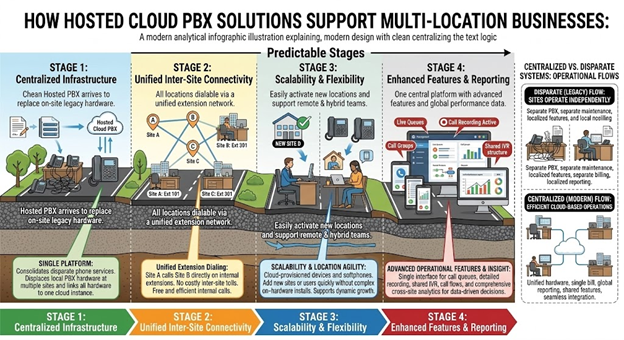
- Centralized infrastructure connects offices, departments, and remote employees under one managed system, so calls move smoothly between locations.
- Managers can standardize hours, auto attendants, call queues, and escalation paths while IT teams handle users from one dashboard.
- Customers, parents, and patients reach the right person faster, which protects trust, service quality, and business continuity.
How Hosted Cloud PBX Solutions Improve Multi-Location Business Operations
A centralized cloud phone setup changes the daily rhythm of a business. It improves response times, cuts handoff problems, and helps leaders control quality across every site. The strongest value appears in the places where branch growth usually creates pressure.
Unified Call Management Across Every Office
Call management usually breaks first when a business expands. Each branch builds its own receptionist flow, extension logic, and transfer habits. After a few openings, calls start moving in ways no one can clearly track. A centralized cloud PBX fixes that by placing routing rules, extensions, and overflow paths inside one system.
Businesses can keep one main number, direct callers by department or location, and move overflow traffic to another office when volumes rise. A customer still experiences one connected business, not scattered branches.
Consistent Customer Experience
Brand trust depends on consistency. If one office sounds polished and another sounds unprepared, customers notice it fast. Cloud PBX platforms help standardize the parts of communication people judge first, including auto attendants, hold flows, voicemail handling, and after-hours routing. That creates a steadier experience across branches.
It also improves speed because teams can route calls by role, urgency, or service type instead of tying them to one desk or building.
Remote Workforce and Mobile Accessibility
Business communication no longer stays inside office walls. Sales teams travel, managers move between sites, and many staff now work hybrid schedules. Cloud telephony supports that shift by letting employees use approved mobile apps, laptops, or desk phones while staying within company rules.
Calls still route correctly, voicemail still lands in the right place, and managers still see activity through the same reporting layer. If one site closes because of weather or an outage, another team can pick up calls without breaking continuity.
Simplified IT Management and Maintenance
Legacy phone systems place too much weight on local hardware, carrier coordination, and office-level troubleshooting. That structure becomes expensive as the business grows. Hosted systems remove much of that burden.
Providers manage the core infrastructure, while internal teams handle user permissions, call flow updates, and policy settings through one software interface. New hires can be activated quickly, department changes become easier to manage, and administration stays more consistent from one location to the next.
Scalability When Expanding to New Locations
Expansion exposes weak communication systems fast. A new branch often means new numbers, queue rules, extensions, and call recording policies. With older systems, each site adds fresh complexity. Cloud PBX makes expansion more repeatable. Businesses can apply proven call templates, add users faster, and launch new locations without rebuilding the entire phone setup.
That creates more control over rollout speed and reduces the cost pressure tied to on-site equipment at every branch.
Built-In Collaboration and Communication Tools
Multi-location communication now depends on more than voice. Teams need calling, meetings, messaging, and shared coordination tools that work together. When those tools sit in different apps, employees lose time and context. Integrated communication platforms solve that problem by connecting voice with conferencing and team collaboration inside one environment.
That setup works especially well for distributed service teams, training groups, and institutions reviewing hosted cloud PBX solutions for schools, where calls, internal updates, and online sessions often need to run side by side.
How Squibit Supports Centralized Communication for Multi-Location Businesses
Squibit sits in the unified communications space, not as a narrow meeting tool, but as a broader platform that combines web conferencing, virtual classrooms, collaboration tools, and hosted PBX functionality into one environment. That architecture makes it relevant for organizations that need voice and digital collaboration working together instead of side by side.
Its fit becomes clear in multi-location settings. A business can centralize voice communication while also supporting meetings, messaging, and shared digital workflows through the same platform layer. Schools and training providers gain a stronger edge here because the platform also supports virtual classroom use cases and education-focused communication needs.
We position Squibit as a practical choice for organizations that want fewer disconnected systems. It supports cloud-based telephony, remote accessibility, and collaboration in one structure. That reduces platform sprawl and gives teams one cleaner operating model.
A few areas stand out:
- all-in-one communications with calling, conferencing, and collaboration
- education-friendly deployment for schools, universities, and training teams
- cloud delivery with no large on-site phone hardware footprint
- stronger fit for hybrid work and distributed operations
Key Advantages of Hosted Cloud PBX for Growing Organizations
The business case strengthens when leaders compare performance, control, and long-term operating efficiency.
| Area | Operational Value for Multi-Location Businesses |
| Call handling | Routes calls across offices with one logic structure |
| Administration | Lets IT manage users, policies, and reporting centrally |
| Customer experience | Delivers more consistent service across locations |
| Expansion | Supports faster rollout for new branches and teams |
| Remote work | Keeps mobile and hybrid staff inside the business system |
| Cost control | Reduces hardware dependency and local maintenance burden |
The market shift also supports this direction. Studies show 31%–60% of businesses worldwide now use VoIP for communication, and around 78% of U.S. small businesses rely on VoIP platforms often supported by cloud PBX systems. Businesses are moving this way because centralized voice infrastructure helps them scale without multiplying communication problems.
Conclusion
Multi-location growth puts pressure on communication before it breaks almost anything else. Calls start bouncing between offices, staff rely on local workarounds, and customer experience turns uneven. A centralized cloud phone environment fixes that by putting routing, reporting, access, and collaboration into one managed system.
For businesses that want stronger control across branches, remote teams, and customer touchpoints, hosted cloud PBX Solutions offer a direct path to better performance. If your team is ready to unify communication across every location, contact us today and let us build the right system for the way we work.
FAQs
How does a hosted PBX differ with a traditional on-premise PBX?
A hosted PBX is a cloud-based service operated by an operator. A conventional PBX requires hardware that is located at the business location. Hosted systems reduce local maintenance, are able to access remotely, and have the ability to scale in a faster manner across multiple offices.
Is it possible to have a multi-campus school district with a single phone system across all the locations?
Yes. The cloud PBX is capable of linking campuses, departments, and administrative staffs with a single phone house. Directories, voicemail and reporting are still handled at the district level, but the districts are able to assign local call paths.
What happens with the after-hours calls with cloud PBX systems with businesses that have multiple locations?
They rely on time-based routing, voice automatic attendants, voicemail policies, and escalation reasoning. A firm can forward calls that occur after hours to an answering staff, an emergency contact route, or a call to the next-business-day response queue.
Do cloud PBX platforms work with desk phones and softphones at the same time?
Yes. Most business deployments support IP desk phones, desktop softphones, browser access, and mobile apps together. That lets companies support office staff, hybrid employees, and field teams without separate systems.
What should businesses check before moving to a centralized cloud phone platform?
They should review internet reliability, call flow design, user roles, device policies, compliance needs, and reporting requirements. A clean migration plan should also map every location, main number, department queue, and after-hours rule before deployment.